

When you're developing a new drug, every patient sample is precious. You're racing to understand your drug's mechanism of action, track how patients are responding in clinical trials, and extract every possible insight from a limited and irreplaceable sample. There are plenty of tools designed to help with this, but none are quite as powerful and sadly underappreciated as Mass Cytometry (CyTOF).
It's a little heartbreaking that mass cytometry hasn't had its moment in the spotlight. The instrument has a real learning curve and it isn't cheap to run. Thus, this remarkable platform quietly does its thing while flashier tools get the headlines. In the hands of a skilled and knowledgeable team, however, mass cytometry is an absolute workhorse. No other platform can pull the same depth and breadth of information from a single clinical sample.
So consider this an appreciation post, a love letter, and a gentle plea to the scientific community to take a closer look at one of the most powerful instruments in the drug developer's toolkit.
Simultaneously resolving T cell subsets, B cell maturation states, NK activation, monocyte polarization, and dendritic cell subtypes in a single tube is a regular Tuesday experiment. Every cryovial in your freezer represents a patient who sat in a clinic chair and rolled up their sleeve. Those cells cannot be replenished on demand, so extracting maximum biology from minimum volume is not a preference but a scientific obligation.
CyTOF separates analytes by atomic mass, so a Gadolinium-155 signal stays in its lane. There is no compensation matrix, no unmixing error compounding across parameters. For trials where data integrity is subject to regulatory scrutiny, that removes an entire class of reproducibility risk.
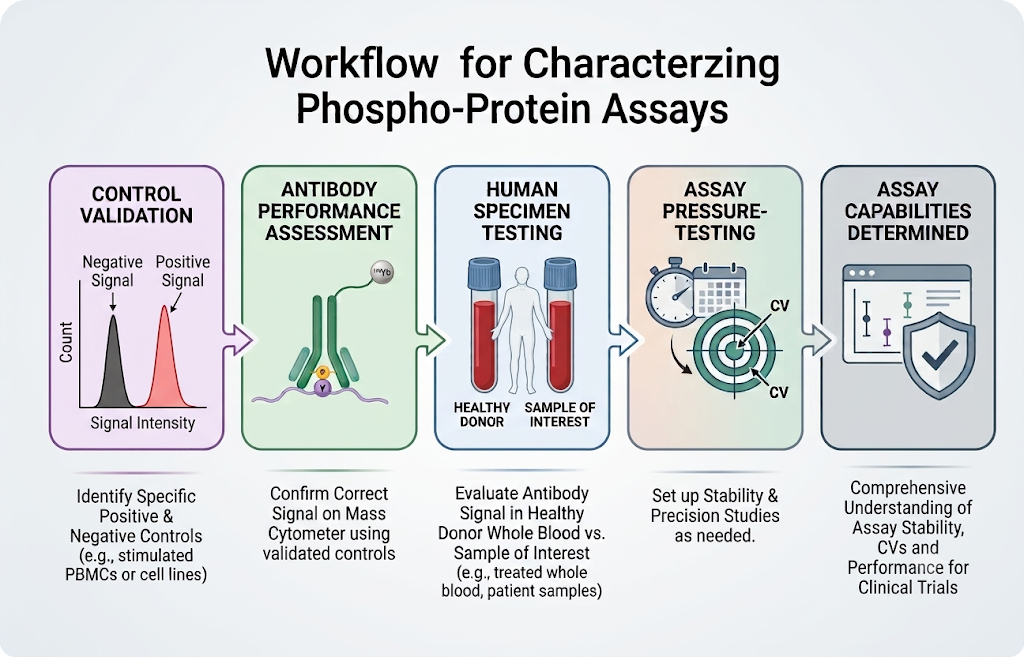
Fixation and permeabilization increase cellular autofluorescence, and that background compounds exactly where you need signal most: low-abundance intracellular targets. Because metal isotopes carry no autofluorescence penalty after permeabilization, cytokines, transcription factors, and phosphoproteins resolve with the same clarity as surface markers. Cohen et al. (Cytometry A, 2026) demonstrated superior CyTOF signal resolution across all three target classes in the first direct head-to-head comparison of mass and fluorescent cytometry for intracellular detection. For trials measuring functional immune states and signaling activity, that clarity changes what you can conclude from a dataset.
Metal-isotope barcoding pools samples into a single acquisition, so every cell sees identical staining conditions and instrument settings. Differences between baseline and on-treatment samples reflect biology, not instrument drift or a reagent that performed differently on a Thursday.
CyTOF's zero-autofluorescence background resolves plasmacytoid dendritic cells, exhausted progenitor cells, and antigen-specific lymphocytes that fluorescence platforms bury in noise. Acquisition is slower than spectral systems, and cell loss during preparation is real. You compensate by putting more in, and the throughput ceiling quietly enforces batching with barcoding, which reduces the variability that speed alone cannot fix.
The immune signature associated with durable response might live in a CD8+ T cell cluster your panel was not specifically designed to resolve. With 40+ parameters feeding the algorithm, it gets resolved anyway. Drug development is expensive precisely because biology surprises us; a deeper panel reduces the probability of missing the signal that explains everything.
CyTOF is not a perfect instrument, and none are. Thoughtful panel design, rigorous sample preparation, as well as technical and analytical investment are all required to get the most from mass cytometry. But when the scientific question is serious, the samples are irreplaceable, and the biology is complex, CyTOF is the platform that rises to meet the moment. For clinical trial immune monitoring, that is exactly the right place to start.
Questions about CyTOF panel design or clinical trial immune profiling workflows? Reach out to our team at Teiko.

.png)