.png)


.png)
Collect blood
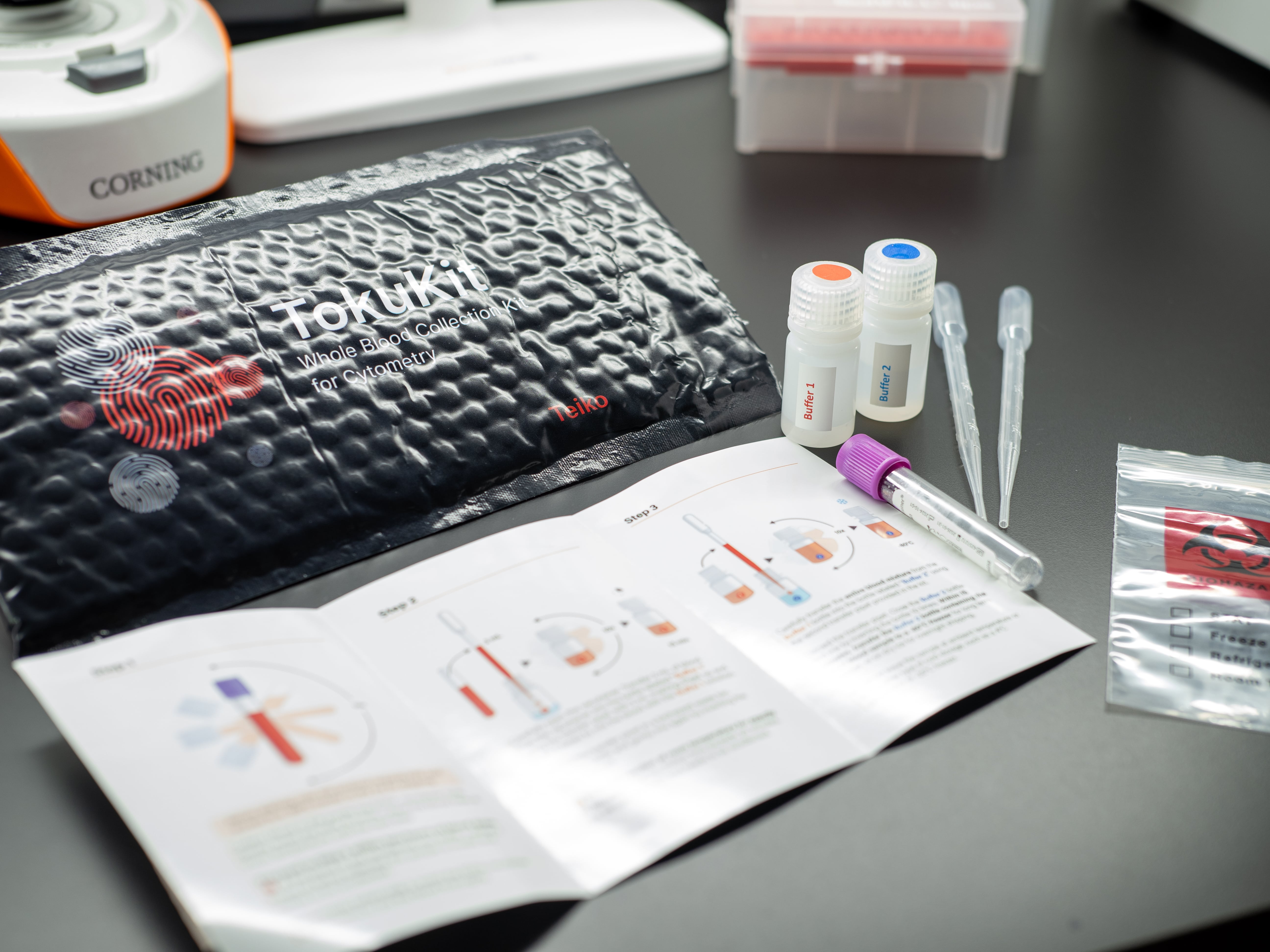
Collect at least 2 mL of blood into a 4 mL vacutainer at the clinical site and invert 10×.
Preserve immune cell populations and functional marker subsets for up to 24 months.
A three-step, centrifuge-free process that can be done at any global trial site.
Summary only — explore every population in Claim 1 below.
Fresh vs fixed · population frequencies
Mass cytometry
r = 0.998
n = 3 donors · 37 populations · pooled r
Spectral flow
r = 0.98
n = 3 donors · 38 populations · pooled r
Mass cytometry · stable up to 24 months
Spectral flow · stable up to 6 months
Stability vs baseline · population frequencies
Mass cytometry · M24
r = 0.998
M24 vs M00 · n = 3 donors · 36 populations · median r
Spectral flow · M06
r = 0.998
M06 vs M00 · n = 3 donors · 35 populations · median r
Collect at least 2 mL of blood into a 4 mL vacutainer at the clinical site and invert 10×.
.png)
Transfer 2 mL of blood to Buffer 1; incubate at room temperature for 15 minutes.
.png)
Transfer entire blood mixture from Buffer 1 to Buffer 2; store at −80°C or ship on dry ice.
Fixation concordance stays high across measured immune populations, with pooled Pearson r of 0.998 for mass cytometry and 0.98 for spectral flow versus paired fresh specimens.
Specimens hold within 3% CV at -80°C for 24 months on mass cytometry and 6 months on spectral flow, allowing retrospective batches across every trial timepoint.
Teiko titrated each clone on this list using staining index, arcsinh ratio, positive/negative separation, and spillover into neighboring channels.
TokuKit was tested across real collection and shipping workflows — including the timing windows sites need in practice. Step through each stage to see the data.
This protocol can be done at any clinical trial site. See it in action.
Handled like PK and ADA samples in your lab manual — PPE only, no special equipment. Works with central labs including ICON, PPD, and LabCorp.
“This is [like] the other samples that are being handled per Lab Manual — PK samples, ADA samples, etc., where tube is spun and serum transferred out and aliquoted.”
— Translational scientist, publicly traded immunotherapy companyYes. Teiko integrates complete blood counts from your central lab with cytometry data from TokuKit-fixed samples to calculate absolute cell counts.

%20(2).png)
%20(3).png)
Instruction manuals, safety data sheets, and regulatory documentation.
Regulatory Documentation
Nalgene Tubes — Regulatory GuideNalgene Tubes — ISO 13485:2016 Certification

