Teiko launches fit-for-purpose phospho flow assay development for clinical trials
Teiko's new FFP Phospho Flow Assay Development service provides custom phospho cytometry assay development for PBMCs and TokuKit-preserved whole blood, supporting pharmacodynamic biomarker development, mechanism of action studies, and longitudinal immune monitoring.
Phosphorylated proteins provide one of the most direct measurements of intracellular signaling and pharmacodynamic activity. Unlike total protein expression, phospho proteins measure pathway activity, allowing drug developers to determine whether a therapeutic is modulating its intended signaling pathway.
Teiko's new fit-for-purpose Phospho Flow Assay Development service enables researchers to develop custom phospho cytometry assays for PBMCs and TokuKit-preserved whole blood, supporting pharmacodynamic biomarker development, mechanism of action studies, and longitudinal immune monitoring.
Developing a FFP phospho assay
Every phospho assay is developed around the scientific objectives of the study. Assay development is led by Teiko in close collaboration with the study team. Throughout development, drug developers provide input on assay design, phospho targets, and assay conditions while optimization, testing, and validation are performed before clinical samples are analyzed.
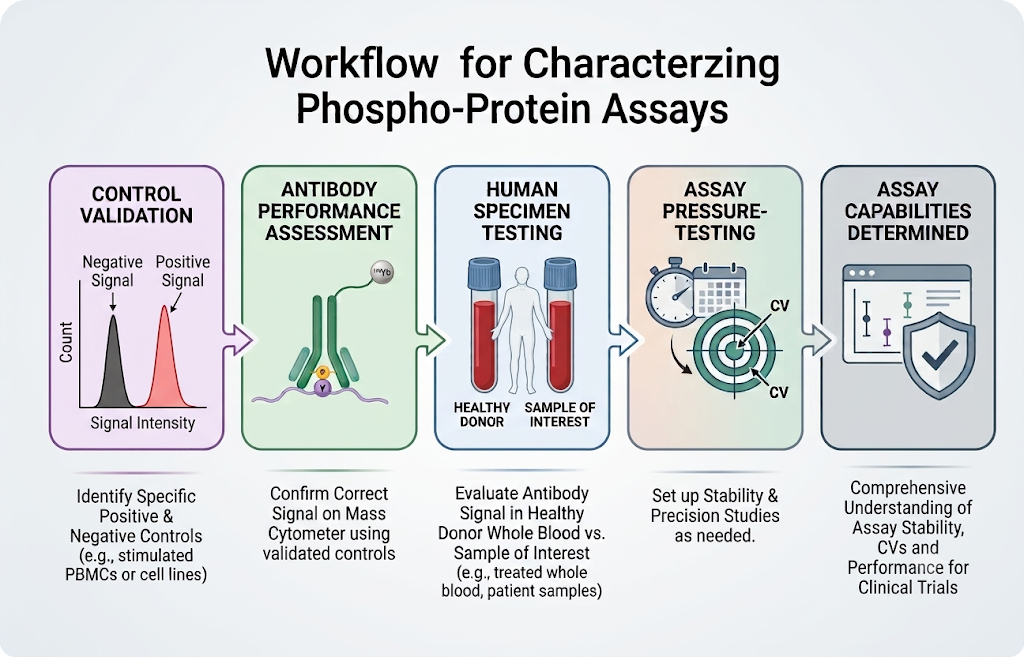
Development includes:
- Selecting phospho targets associated with the therapeutic mechanism
- Evaluating phospho-specific antibody clones
- Optimizing permeabilization and stimulation conditions
- Validating assay performance to detect phospho levels on immune populations and functional marker subset
At the completion of phospho assay development, a Panel Verification Report is provided for review. Once approved, clinical trial sample processing begins using the validated assay.
PBMCs and whole blood
Most phospho assays are developed using PBMCs because they allow controlled stimulation experiments during assay development.
Teiko also develops phospho assays for TokuKit-preserved whole blood. TokuKit preserves phosphorylation immediately after blood collection, before PBMC isolation or cryopreservation. Samples can then be stored at -80°C and analyzed together. This allows every patient timepoint to be processed in the same batch.
.png)
Why it matters
FFP phospho assays enable drug developers to evaluate signaling pathways throughout a clinical study by helping them:
- Predict patient response by measuring pharmacodynamic changes before and after treatment.
- Understand mechanism of action by measuring signaling downstream of a therapeutic target.
- Track disease status by comparing phosphorylation changes across study visits.
Availability
FFP Phospho Flow Assay Development is available now for PBMCs and TokuKit-preserved whole blood. Every project includes phospho marker selection, clone evaluation, assay development, validation, precision testing, and assay performance reporting. For assays developed with TokuKit, Teiko also offers phospho marker stability testing following whole blood preservation.
Learn more
The launch accompanies a technical article by Kristina Magee, PhD, Cytometry Expert at Teiko, titled "Phospho Signals Are Fragile; Here's How We Figured Out To Measure Them Anyway." The article explores how phosphorylation regulates intracellular signaling, why phospho assays are sensitive to sample handling, and the considerations involved in developing phospho cytometry assays.
Ready to develop your phospho assay?
Start a project or visit the Custom Phospho Flow Assay Development webpage to learn more.