
Many of today's therapeutics are targeting a kinase (actually, there are 94 FDA-approved protein kinase inhibitors, 10 of which were approved in 2025). When a drug targets a kinase, the most direct way to know whether it is actually engaged with its target is to measure the abundance of the kinase’s product, the phospho-protein.
Measuring phospho-proteins are wonderfully direct pharmacodynamic (PD) readouts. Unfortunately, (like everything in life?) good things are hard to get. Read on for the reasons why, and how we get them anyway.
.png)
Kinases work by adding a phosphate group to a protein, and that phosphorylation is what switches a signaling pathway on or off. So if a drug inhibits a kinase, the phosphorylated form of its downstream substrate will go down. While one can measure the abundance of a phospho-protein directly, and with that have a great read-out for target engagement, these assays are fairly complex. A single protein usually has multiple phospho-sites, meaning several amino acids in its sequence that can each receive a phosphate. Different kinases often act on different sites. If a drug's target phosphorylates a unique site, you can sometimes build an assay around that exact site and get a remarkably specific readout of your drug's activity, rather than a general measure of pathway activity.
To get to this readout though, you need to start with antibodies that recognize only that specific phosphorylated version of the protein, not the total protein pool. If not carefully validated, you're measuring the wrong thing entirely.
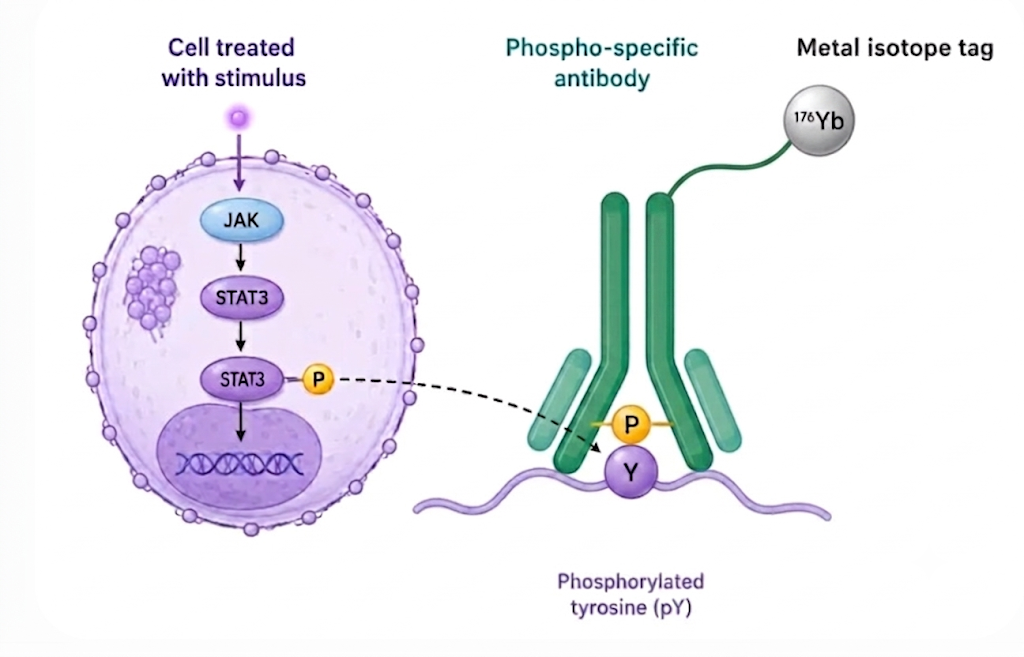
Measuring a specific phosphorylation is an incredibly useful and also delicate assay in drug development. The signals are transient by nature and remarkably easy to disrupt. With cultured cells for example, we’ve learned that simply taking the dish out of the incubator and handling it can shift phospho-levels, because the cells sense that change as a stress and alter their signaling in response. Basically, it feels like you are trying to capture a snapshot of something that reacts to being observed.
This fragility collides head-on with how clinical trials usually run cytometry. The field leans heavily on cryopreserved PBMCs, because they're easy to ship and store. But freezing and thawing cells is an enormous stress. It can artificially inflate certain phospho-signals such as some of the pSMADs, and it can just as easily erase others, because the signaling cascade you cared about was shut off somewhere between the freezer and the analyzer.
The common workaround is to stimulate the thawed PBMCs with a compound to re-induce the phospho signal. Sometimes that's genuinely what you want, for example measuring how a patient's cells respond to a defined stimulus after drug treatment. But as a routine trial assay, it's cumbersome and has a high failure rate. PBMCs are already tricky to isolate and thaw with good viability, and then you're asking a CRO to culture and stimulate them, often with complex protocols and specialized requirements like FBS starvation.
Every added step is another place for the assay to fail.
Phospho-cytometry is also where mass cytometry genuinely shines. Because phospho-signals live inside the cell, you have to fix and permeabilize the sample to reach them. That process increases autofluorescence, which is a real headache in flow cytometry. It can absolutely be done, but panel development becomes cumbersome and takes both experts and time to iterate through.
Mass cytometry solves the problem head on. Antibodies are tagged with metal isotopes rather than fluorophores, and detection is by mass time of flight. Autofluorescence simply isn't part of the equation, which removes one of the biggest obstacles to building a clean phospho panel.
Ex-vivo stimulation assays absolutely have their place. They're especially valuable when validating a new antibody clone, because as mentioned above, you need to confirm that the clone is really tracking the specific phospho signal and not just total protein. That validation work is essential, and we always rely on it when testing a new phospho-target.
But for assessing phospho signatures across a clinical trial, we think whole blood is a great (potentially better) alternative to PBMCs, and one that can avoid ex-vivo PBMC stimulation inside the trial altogether. Our TokuKit preserves whole blood for cytometry and, importantly, preserves phospho signatures along with it. We've tested a range of phospho markers (pERK, multiple pSTATs and pSMADs, pS6, p38, pIKBA) and shown that their signatures hold up after extended storage at -80°C.
If you are interested in developing a specific phospho-readout with us, here’s how we would generally go about that:
Firstly, we verify that we can detect your specific phospho-target of interest by using positive and negative controls (ie above mentioned ex-vivo stimulated samples). Once verified, we typically measure the signal in whole blood from healthy donors and compare it to a specimen of interest (this can be whole blood treated with your compound ex-vivo, or whole blood from a patient with a specific disease). This comparison will give you a sense of what to expect from clinical trial samples. From there, based on your needs, we pressure-test the assay (usually stability and precision testing), so you have confidence in the stability of your signal and know the coefficient of variation.

Using preserved whole blood in your trial rather than PBMCs does two things:
First, it lets you measure the phospho signal as it actually was in the patient at the moment of the blood draw, rather than a signal distorted by isolation, freezing, and re-stimulation.
Second, it lets you batch process samples. You can hold an entire patient time series and run every sample together in a single go, so you're reading phospho-signal dynamics across the trial without any batch-to-batch variation muddying the picture.
For a phospho readout, where the signal is fragile and the whole point is to measure small changes over time, removing that variation can be the difference between an unreadable, noisy set of numbers and an actionable PD insight that influences clinical decisions.

.png)
.png)