
In short: We validate antibodies by testing different antibody clones, concentrations, and cellular conditions to optimize signal-to-noise ratio and reduce background noise, ensuring accurate identification of cellular markers.
Our customers often want to know that when we have a cellular marker on our panel, such as CD45, we can confidently distinguish this cellular marker signal from background noise. To detect a cellular marker, we need a corresponding clone.
But not all clones are created equal. For instance, here's an example of two different CD45 antibody clones tested on human cells with very different results. Can you see the difference?


To that end, our immunologists use their extensive expertise to reduce mass cytometry panel validation time from months to weeks, using proven techniques.
Problems with standard approaches:
Traditional approaches would use panel design software alone to assign markers to channels, however standard panel design software approaches have crucial limitations. Specifically, these approaches:
Imagine you need a marker that’s not sold by the manufacturer: at this point, you need an expert to figure out what the right clone and concentration is. And if you don’t happen to have an expert handy, and you get the wrong clone or concentration: that could yield “bad or missing signals” on a panel, and ultimately unuseable data for precious samples.
Now, let’s compare our approach.
Our process:
We pair the best of software design with expert scientist intuition. Teiko scientists and immunologists have collectively processed over 2,800+ samples and 25 panels, yielding many hard-won lessons about panel design.
Ultimately, for a 44-marker panel, the goal of this process is to produce a 44 X 5 table:
| Marker | Channel [44 total] | Antibody Clone | Antibody Concentration (µg/ml) | Cellular conditions for signal detection |
|---|---|---|---|---|
| CD45 | [89Y, 112Cd, ..., 209Bi] | [C1, C2, ... CN] | [6, 3, 1.5, ... 0.1875] | [Stimulated PMA, Stimulated PHA, Unstimulated] |
| CD8a | [89Y, 112Cd, ..., 209Bi] | [C1, C2, ... CN] | [6, 3, 1.5, ... 0.1875] | [Stimulated PMA, Stimulated PHA, Unstimulated] |
| ... | ... | ... | ... | ... |
| CD45RA | [89Y, 112Cd, ..., 209Bi] | [C1, C2, ... CN] | [6, 3, 1.5, ... 0.1875] | [Stimulated PMA, Stimulated PHA, Unstimulated] |
The first thing we do is look at the literature and antibody vendors and see if a marker of interest has been tested before. For each marker, i.e. CD45, we’ll figure out which antibody clone (i.e. HI30) to use based on historical performance.
Then, we’ll determine which channel to use to get the “maximum” signal to noise ratio. In general, Teiko’s experts follow a few rules that sound simple but require a lot of knowledge to execute quickly:
Our experience with channel placement is where our experts can save you weeks of time and frustration.
After finding the right channel, we determine the “optimal” antibody concentration to get the maximum separation between signal and noise. We plot this “stain index” on a curve to find the right concentration.
This is how we generate the stain index:
The end result is a fully populated table and completed validation:
| Marker | Channel [44 total] | Antibody clone | Antibody Concentration (µg/ml) | Cellular Conditions for Signal Detection |
|---|---|---|---|---|
| CD45 | 89Y | C2 | 1.5 | Unstimulated |
| CD8A | 209Bi | C1 | 0.1875 | Unstimulated |
| … | … | … | … | … |
| CD45RA | 112Cd | C3 | 3 | Stimulated PMA |
What is your process for validating new antibodies and adding them into my customized panel?
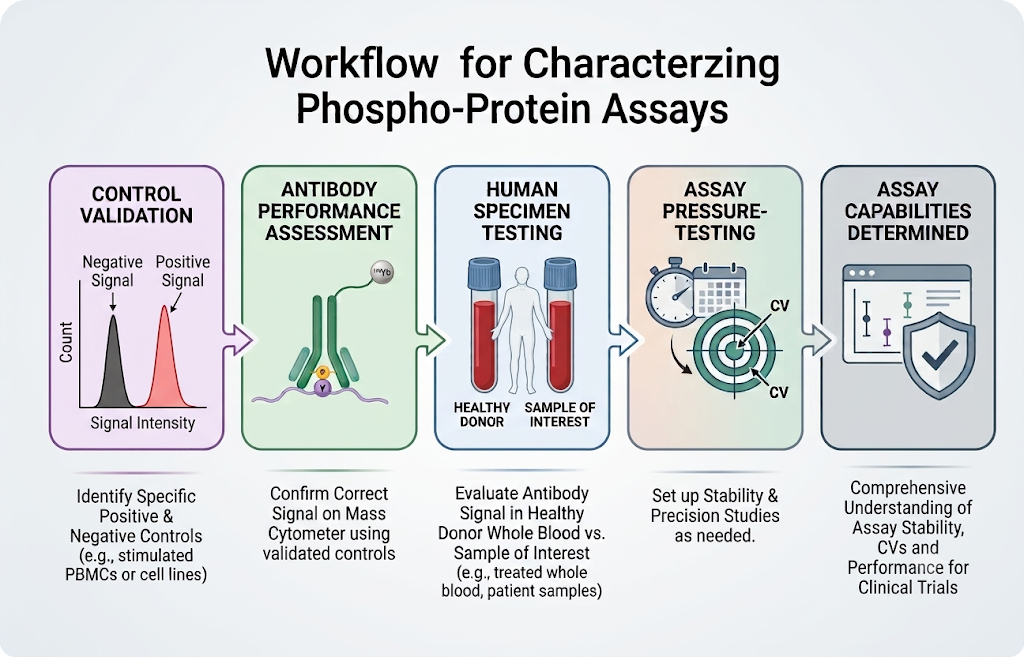
Using a process very similar to how we validated our base panels, we verify the optimal staining concentration at which each metal-conjugated antibody demonstrates a detectable and accurate signal on the mass cytometer, while minimizing background signal and spillover into other channels. Once titrated and validated individually, these antibodies are added to the panel and the full panel is then validated.
In sum
That’s a lot of heavy lifting behind the scenes. And we do that in weeks, not months. Teiko scientists performed this process to design all of our current Custom backbone and Standard panels.


.png)