Teiko CSO to present TokuKit’s two-year whole blood stability results at CYTO 2026
Li-Chun Cheng, PhD, shares new findings showing TokuKit-processed whole blood samples maintain immune cell frequencies and expression levels (R > 0.99 compared to fresh sample) for 2-years, making the need for live sample processing a thing of the past.
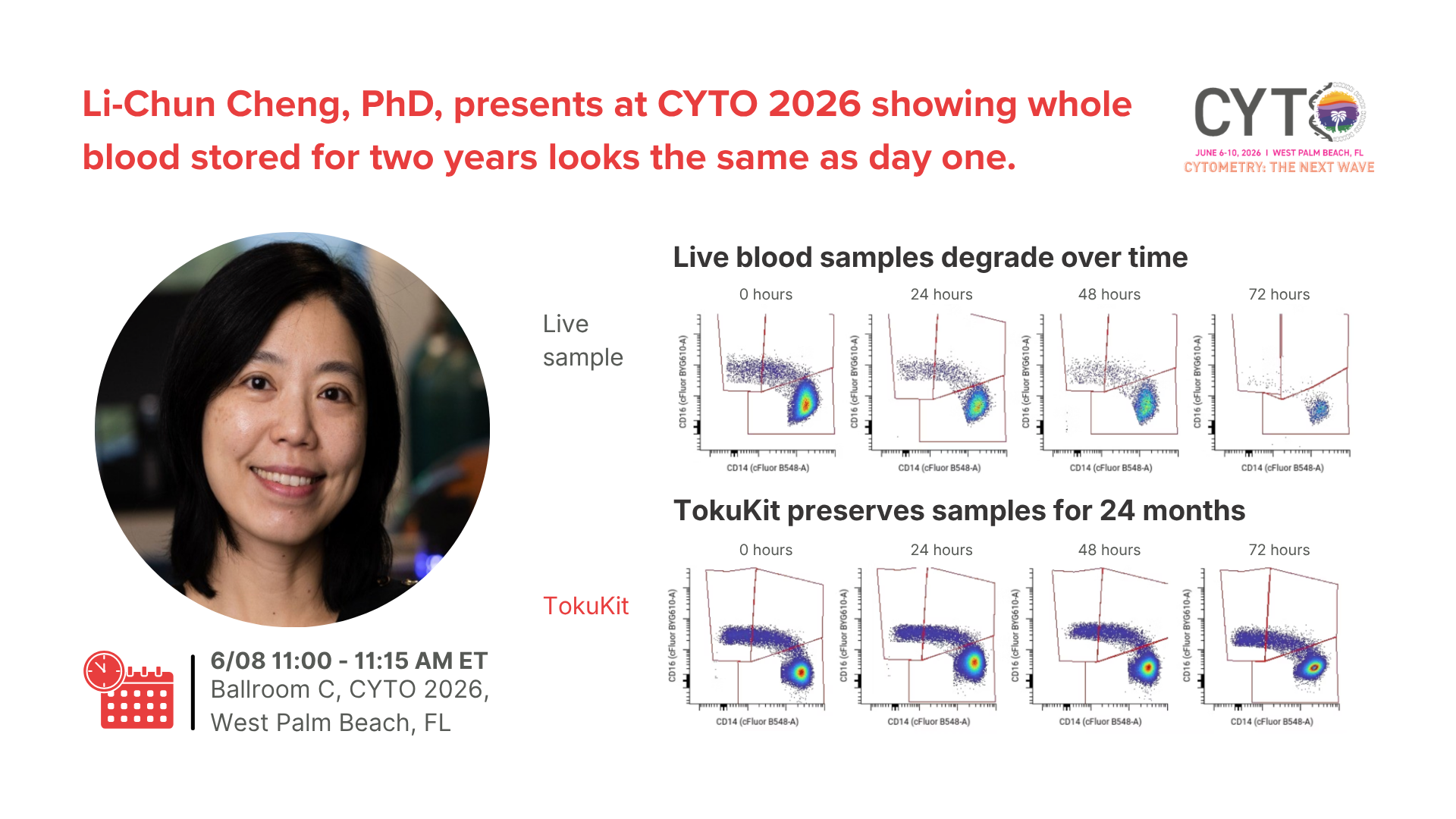
Li-Chun Cheng, PhD, shares new findings showing TokuKit-processed whole blood samples maintain immune cell frequencies and expression levels (R > 0.99 compared to fresh sample) for 2-years, making the need for live sample processing a thing of the past.
June 4, 2026 — Teiko’s Chief Scientific Officer Li-Chun Cheng, PhD, will present original research at CYTO 2026 on June 8, 11:00–11:15 AM ET in Ballroom C, West Palm Beach, FL.
The talk, titled Solving Immune Marker Degradation: Two-Year Whole Blood Stabilization for Multiparameter Cytometry, presents validation data demonstrating that whole blood stabilized with TokuKit and stored at -80°C maintains immune cell biology across 24 months of storage, matching the results of same-day fresh processing.
Live blood processing is breaking clinical trials
The moment blood leaves a patient, the clock starts. By 24 hours, 15% of cells are already lost. By 48 hours, 32%. By 72 hours, nearly half. More than 20% of clinical trial samples never make it to processing within that window, lost to shipping delays, site scheduling, and lab capacity. But even samples that arrive on time aren't spared — myeloid populations degrade fastest, and CD45RA loss alone causes naive and memory T cell subsets to appear to shift, introducing phenotypic bias before a single sample has been run.
.png)
Across multicenter trials, these losses add up. Missing or degraded samples mean smaller datasets, inconsistent results across sites, and immune profiles that no longer reflect what was happening in the patient. That is the same data teams rely on to make dosing decisions and understand how a therapy is working.
A kit that buys time
TokuKit stabilizes whole blood at the point of collection through a three-step, centrifuge-free process in under 20 minutes. Samples store at -80°C and ship to a central laboratory whenever the trial is ready. Using a CLIA-validated 41-marker mass cytometry panel on a Helios CyTOF, TokuKit-fixed samples correlated with fresh same-day samples at R > 0.99. That agreement held at 24 months: R > 0.99 across 36 immune cell populations, R = 0.96 across 180+ functional marker subsets, and R = 0.96 for marker expression levels including intracellular transcription factors Tbet and TCF1.
.png)
When the processing window is no longer a constraint, sites collect and ship on their own schedule, central laboratories batch process consistently, and longitudinal studies can bank and analyze samples together.
TokuKit is now deployed across 30+ global Phase I-IV clinical trials and 117+ clinical sites.
Come find us at CYTO 2026 and reach out to set up a meeting. We'd love to connect!
Solving immune marker degradation: two-year whole blood stabilization for multiparameter cytometry Presenter: Li-Chun Cheng, PhD, Chief Scientific Officer, Teiko Date: June 8, 2026 | 11:00-11:15 AM ET | Ballroom C, CYTO 2026, West Palm Beach, FL
Learn more at teiko-labs.com/tokukit